
The 10 Fastest-Growing Skills Transforming Cybersecurity Jobs

Cybersecurity skills are evolving faster than ever. How can cyber professionals keep up?
Cybersecurity has never been a profession for those who embrace the status quo. New threats arise daily, regulations evolve rapidly, and emerging technologies are adopted at a dizzying pace. The result is a revolving door of responsibilities for cybersecurity teams, which creates an ever-expanding set of required skills and competencies. This poses a fundamental challenge for the cyber workforce: if the landscape keeps shifting, how can cybersecurity professionals adapt quickly enough to keep up?
Compounding the issue, the pace of skill change is accelerating, both in cyber and across the workforce more broadly. A recent report from our partners at Lightcast, “The Speed of Skill Change,” found that the top skills required in roles across the economy are shifting more rapidly than in the past. FourOne Insights’ own analysis has found that since 2023, 23% of core skill requirements in cybersecurity have changed. In other words, cybersecurity professionals must refresh nearly one in four skills every two years.
But what is driving this accelerated skill change? Is it all due to AI, or are other factors also to blame? To keep pace, cybersecurity professionals must track which skills are evolving fastest. Otherwise, they risk their expertise becoming obsolete, putting our digital infrastructure increasingly at risk.
Identifying the Fastest-Growing Skills in Cybersecurity
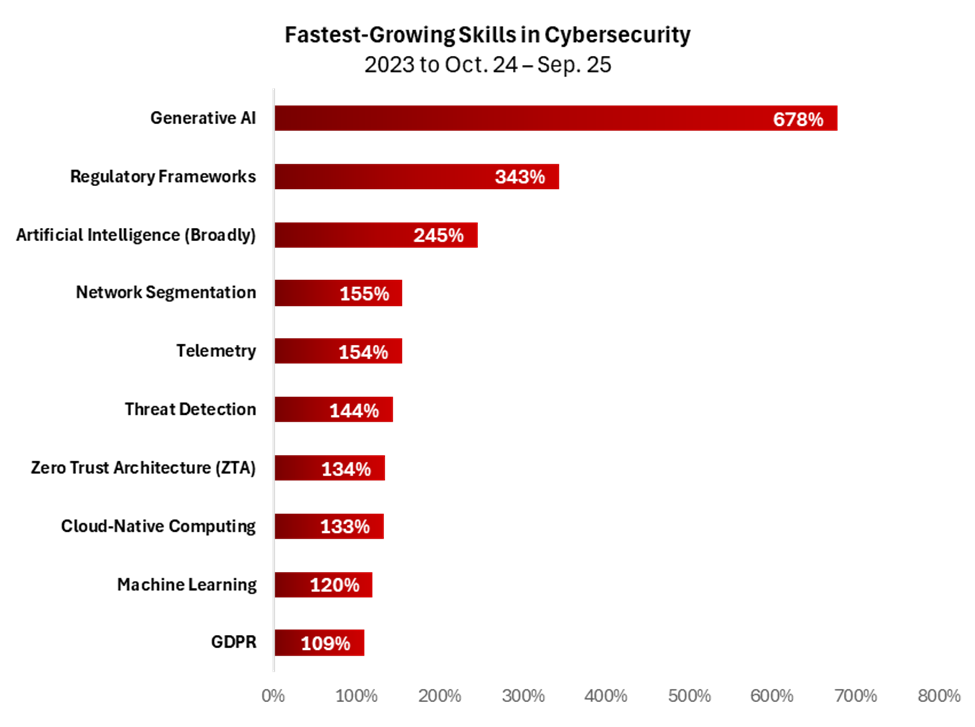
To better understand where cybersecurity roles are heading, FourOne Insights analyzed job postings to track how employer demand for specific skills has evolved since 2023. We then identified the 10 fastest-growing skills in cybersecurity since 2023 to pinpoint the capabilities expanding most rapidly across the field. The resulting list of skills is detailed in the following chart.
Source: FourOne Insights analysis of skills requested in job postings from Lightcast
Unsurprisingly, skills related to artificial intelligence are leading the pack. Generative AI tops the list, with demand jumping a staggering 678% in under two years – nearly twice the growth rate of any other skill. Similarly, broader artificial intelligence knowledge and machine learning also appear among the ten fastest-growing skills in cyber.
However, the AI surge tells only part of the story. Rapid growth is also occurring in skills related to regulation – such as regulatory frameworks and GDPR – as well as emerging security techniques and practices, such as network segmentation, telemetry, threat detection, and zero trust architecture. Cloud skills continue to expand as well, with demand for cloud-native computing increasing 133% among cybersecurity professionals since 2023.
Emerging Skills are Expensive and Hard to Fill
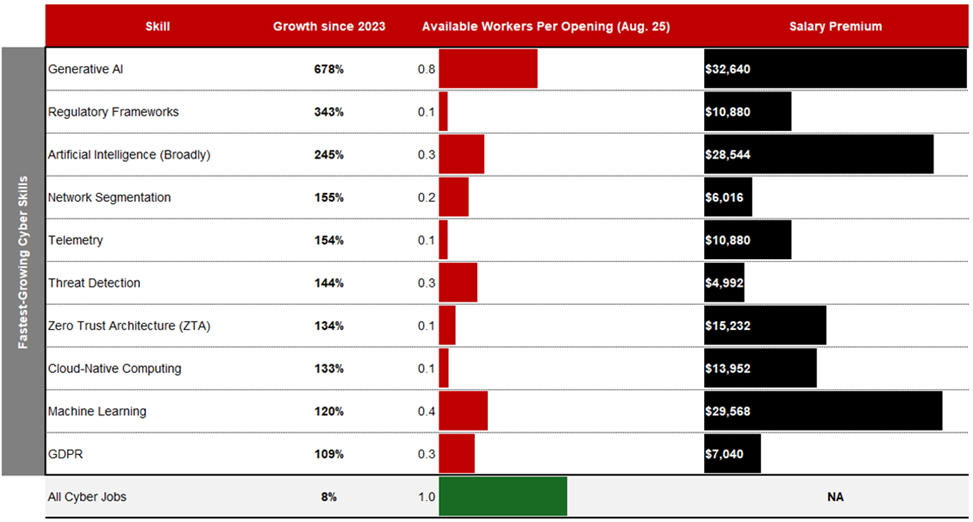
Rapid growth in demand often brings growing pains, and these emerging skills are no exception. As the following chart shows, all 10 of the fastest-growing skills in cybersecurity faced talent shortages as of August 2025, with fewer than one available cybersecurity worker for every opening requesting each skill. Some skills – such as regulatory frameworks, telemetry, zero trust architecture, and cloud-native computing – have only one available worker for every ten openings. That’s a tenfold talent gap – one of the starkest shortages anywhere in today’s labor market. By comparison, the supply and demand for all cybersecurity jobs during the same timeframe, regardless of skills, was almost perfectly aligned.
Source: FourOne Insights analysis of Census Bureau data, Lightcast job postings data, and Lightcast worker profile data.
As a result of these talent shortages, the cost of hiring cybersecurity talent with emerging skills has spiked. Each of the fastest-growing skills commands a significant salary premium over the average pay for all cybersecurity jobs. AI-related skills are driving the steepest pay premiums, often approaching or exceeding $30,000 annually. This places significant financial strain on organizations hiring for these increasingly important skills.
Employers Must Take Ownership of Cybersecurity Training
Given the pace of skill change, organizations can no longer treat cybersecurity training as optional – it’s now a strategic imperative. Cybersecurity professionals, for their part, must also embrace a continuous learner mindset, and educators must adapt their curricula to include emerging skills. But with salaries skyrocketing for new skills, and high-quality training programs being cost-prohibitive for many individuals, the economic onus for reskilling is increasingly falling on employers.
Admittedly, some organizations may bristle at the thought of increased training costs, especially in a period of ongoing economic uncertainty. However, it is far better than the alternative. In fact, it may be one of the highest ROI investments cybersecurity leaders can make. With talent supply for emerging skills so tight, and salary premiums pushing ever higher, training existing employees isn’t just cheaper than hiring – it’s one of the few realistic ways to fill the gap.
As a result, cybersecurity leaders must proactively anticipate and build new skills across their teams. In a field where skills can become obsolete in months, the only sustainable strategy is investing in continuous learning. Skills are evolving too rapidly to rely solely upon traditional training programs, and the economics of hiring from a limited pool of specialists are untenable. By contrast, investing in upskilling delivers strong ROI by offsetting bloated hiring costs, while simultaneously increasing retention, improving team culture, and strengthening organizational resilience. The implication, therefore, is clear: organizations that invest in cyber skill growth today will be best prepared to defend against the digital threats of tomorrow.
