
New Report: Strengthening NYC’s Entry-Level Tech Pathways in the Age of AI
How can we build more resilient entry-level tech pathways in the age of AI?
For more than two decades, tech careers have been one of the most reliable pathways to economic mobility. Workforce organizations, community colleges, and training providers helped thousands of individuals launch well-paying careers in software development, IT, cybersecurity, and data analytics.
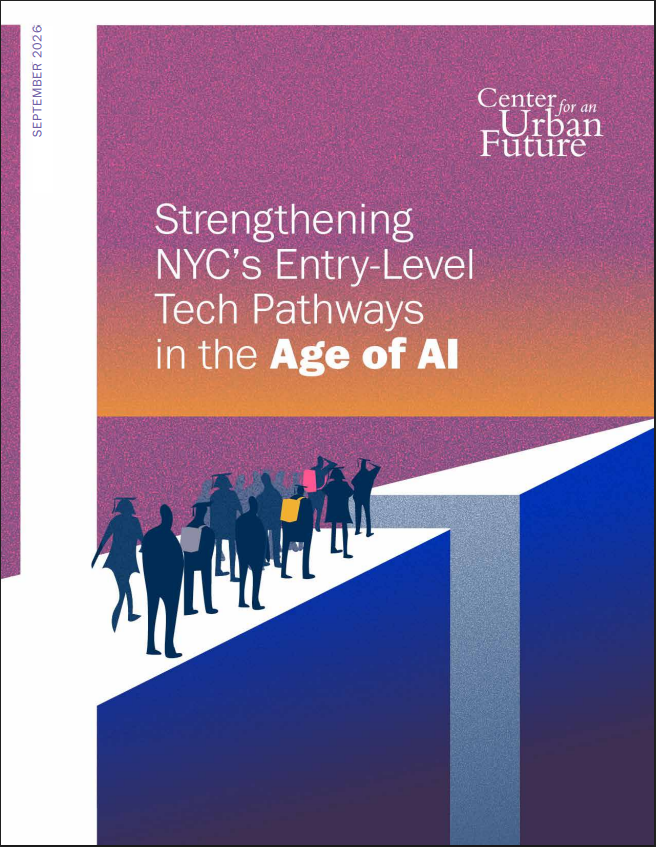
But a new report – “Strengthening NYCs Entry-Level Tech Pathways in the Age of AI” – by the Center for an Urban Future (CUF), researched and authored by FourOne Insights in partnership with CUF, and funded by a grant from Pursuit, finds that these pathways are under growing pressure as artificial intelligence transforms the nature of entry-level work.
The Entry-Level Tech Job Market Has Contracted Dramatically
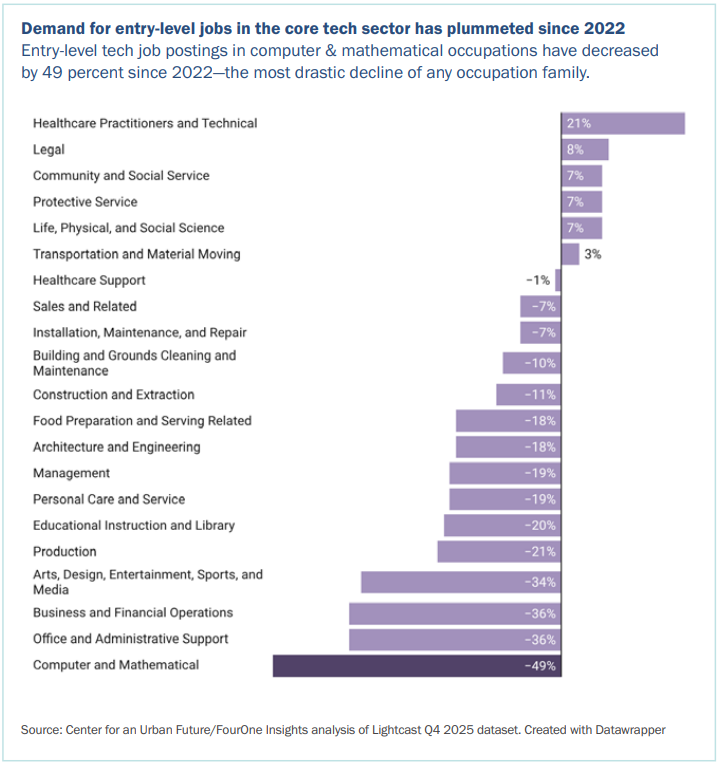
The report reveals that entry-level tech hiring in New York City has declined sharply since 2022. Entry-level postings for computer and mathematical occupations have fallen 49%, representing the steepest decline of any major occupational group in the city.
At the same time, competition for those opportunities has intensified. In 2023, New York City reached a tipping point where the number of new computer science graduates exceeded the number of available entry-level tech positions for the first time on record. By 2024, there were 57% more computer science graduates than entry-level tech job openings.
AI Exposure Is Closely Linked to Declining Hiring
One of the report's most significant findings is the relationship between AI exposure and entry-level hiring demand.
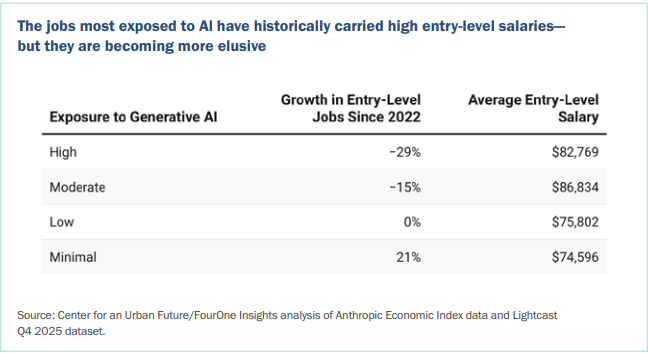
Occupations with the highest levels of generative AI exposure experienced a 29% decline in entry-level job postings since 2022, while occupations with minimal AI exposure saw 21% growth during the same period. Computer and mathematical occupations, which experienced the largest hiring decline, also showed the greatest levels of AI automation and augmentation.
The findings suggest that AI is changing how organizations structure and staff entry-level work. Employers increasingly expect early-career employees to leverage AI tools, contribute more quickly, and combine technical expertise with business, communication, and problem-solving skills.
The News Isn't All Negative
While traditional entry-level tech roles have declined, new opportunities are emerging.
The report found that entry-level job postings requiring AI skills have increased 20% since 2022, making AI-related positions one of the few bright spots in the current labor market. Demand is growing across industries, including healthcare, finance, transportation, education, and professional services.
Meanwhile, the fastest-growing skill requirements in entry-level technology roles are tied directly to AI, machine learning, large language models, data analysis, and AI operations. Demand for generative AI skills has surged dramatically over the past three years.
What This Means for Workforce Development
The core challenge facing workforce organizations, educators, employers, and policymakers is not simply preparing people for existing jobs. It is helping workers build the skills and experience needed for a labor market being fundamentally reshaped by AI.
The report highlights how leading workforce organizations are adapting by embedding AI into their curricula, expanding apprenticeship and work-based learning opportunities, emphasizing applied problem-solving, and helping learners develop both technical and human-centered skills.
At FourOne Insights, we believe these findings underscore the importance of workforce intelligence that moves beyond job titles and focuses on tasks, skills, and emerging career pathways. As AI continues to reshape work, organizations and communities that understand how work is evolving will be better positioned to develop talent, design effective training programs, and create inclusive pathways into the jobs of the future.
The challenge is real, but so is the opportunity. The future belongs not to organizations or communities that resist AI nor those who adopt the technology with blind optimism, but to those that help workers learn to thrive alongside it.
Read the full report here.
Want to learn more about our work on strengthening early career talent pathways? Get in touch.